Grosser Mobil 1 Preis von Deutschland
Grosser Mobil 1 Preis von Deutschland
Michael Schumacher's greatest moment as a racing driver may be remembered as when he was being towed behind a rescue truck. Michael had just won his home Grand Prix - the first German to do so since the 1930s - after driving a brilliant race, winning from the front. After Schumacher had crossed the line - amid scenes of jubilation from the vast German crowd - he slowed his Benetton to wave to them at the first corner and he promptly stalled his car. In the end a tow truck came along, hooked him up, and set off into the tranquil Hockenheim woods where spectators are not allowed to stray. For several minutes everyone in the stadium waited while Michael enjoyed a nature ramble. When, finally, the strange procession appeared back in the stadium area the grandstands went berserk. The air was full of fireworks and thousands of flags were waving. They will be talking of that afternoon for years to come.
Qualifying had been the most interesting of the year with Friday seeing a wonderful session as seven men swapped pole between themselves 14 times. Hill had won that game with Schumacher and Coulthard in his wake while Berger headed a disappointing Ferrari challenge in fourth just ahead of the Jordan-Peugeots with German engine-makers Mercedes making a big effort to get the two McLarens seventh and eighth.
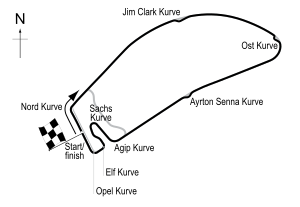
The race, however, was not a very good one. At the first corner on the second lap Damon Hill slid off the track and went hard into the barriers. He was gone and with him went Williams's chance to dictate strategies. With Schumacher ahead, the Benetton race-callers were in the driving seat and the Williams men were guessing. Would Schumacher stop once or twice? Coulthard was looking good on a one stop pattern but the team was outfoxed when Schumacher did two quick stops - later than expected - which gave him a clear lead. If Coulthard had known, he said later, he would have pushed harder in the early laps when Schumacher could not create a big gap. David said it was a victory of experience. He was probably right.
That aside it was a dull race - but a great one. The Ferrari effort, on a track which should have suited the V12, was a disaster. Alési had an engine problem and retired; Berger blew it at the start when the FIA sensors under the track concluded that he had jumped the start. The Austrian drove a strong comeback race to finish up third, although that was only thanks to the retirements of three of those ahead of him - including both McLarens with engine failures.
Behind Gerhard came a steady Herbert and the other survivors: Jean-Christophe Boullion fifth in his Sauber and Aguri Suzuki sixth for Ligier, despite having had an off and a extra pit stop.
After the race Hill admitted that his crash had been "pretty devastating for the championship" but reckoned that it had not been his fault: that something had gone wrong with his Williams. A couple of days later the team admitted that a rear axle showed signs of excessive wear and may have contributed to the accident. Frank Williams and Patrick Head were not amused and with the time coming to take a decision on the drivers for 1996, both Hill and Coulthard found themselves rather in the doghouse. Jacques Villeneuve flew in to England to test for Williams in the days after the test.