Grand Prix de Monaco
Grand Prix de Monaco
Michael Schumacher said after his second consecutive Monaco victory that he loved the most famous street circuit in the world because a good driver can really do well there. He did not need to make the point that he is a good driver. The F1 circus appreciates his talent.
Qualifying was a strange affair because while Jean Alési was fastest on the first day with Gerhard Berger third on the grid, the team shot itself in the foot in final qualifying by deciding to give Alési the chance to use Berger's car. This meant that the car was not really prepared for Jean - and he could not get the most from it - and that Berger might have done better if he had not been under pressure to give his car up.
And so the pole fight became a battle between Schumacher and Damon Hill. Damon won. David Coulthard - a Monaco new boy - did well to get third and Berger and Alési had to make do with fourth and fifth. Häkkinen - a man who does well on ballsy tracks - was sixth in the still difficult McLaren.
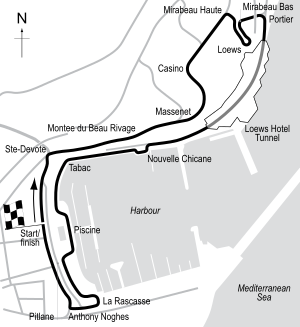
As often happens at Monaco, the race began with a shunt at Ste Devote. The first corner at Monaco is the most critical in F1 racing because if you do not get ahead of the opposition there your chances of overtaking your rivals are limited for the rest of the race, street circuits being so narrow.
When the lights went green this year Hill and Schumacher got through without drama but behind them Coulthard was slower away and found himself in a Ferrari sandwich as the field raced to the first corner: Gerhard Berger on the outside and Jean Alési trying to sneak up on the inside. It was never going to work. The three made contact, the track was blocked and the red flags came out, bringing proceedings to a halt.
Most of the midfield jumped the second start and the stewards handed out no fewer than six 10-second stop-go penalties. With Coulthard, Berger and Alési all in spare cars, Hill and Schumacher were left in a race of their own up front, while Coulthard held up the rest of the field because the spare car had a dodgy throttle.
Williams had decided to cover both options in terms of strategy by running Hill to two pitstops and Coulthard one. The correct option was one stop and - with Coulthard in trouble - Schumacher was ideally placed. As usual the Benetton handled better with a larger fuel load but struggled when the gas had been burned away. In among the backmarkers, however, Hill failed to make a break when he might have done and so lost his advantage.
You can call it luck that the only men on the same pit stop strategy as Schumacher - Coulthard, Alési and Häkkinen - fell out of the race before they could ever make a proper challenge. Häkkinen went after eight laps with a Mercedes engine problem; Coulthard's challenge ended early with another gearbox electronics problem and Alési - chasing Schumacher hard after Hill and Berger (the other two-stop runner in the race) had pitted - was taken out when Martin Brundle spun his Ligier in front of Jean's Ferrari.
This left Schumacher with a 15 second lead over Hill and Damon needing to stop again. Game over.
Berger finished third, Herbert fourth, Blundell a good fifth with Frentzen again picking up a point for Sauber - which was a boost for the Swiss team which had been forced to dump Karl Wendlinger because of his failure to perform in the early races. His place was taken by Jean-Christophe Boullion.